TSM Thermal System Module - Advanced Temperature Management Solutions for Industrial and Commercial Applications

Get a Free Quote

Our representative will contact you soon.
Email
Name
Company Name
Message
0/1000

tsm

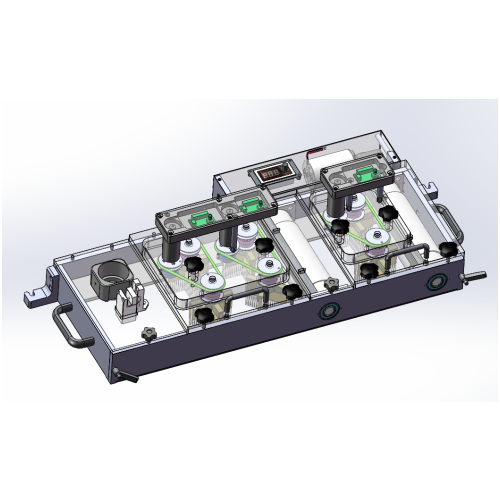
The TSM, or Thermal System Module, represents a cutting-edge solution in temperature management technology designed to address the complex thermal challenges faced by modern industries. This sophisticated system integrates advanced heat transfer mechanisms with intelligent control capabilities to maintain optimal operating temperatures across various applications. The TSM employs a combination of active cooling components, passive heat dissipation elements, and precision sensors that work in harmony to deliver consistent thermal performance. At its core, the TSM utilizes proprietary heat exchange technology that maximizes surface area contact while minimizing energy consumption. The system features modular architecture, allowing users to scale thermal capacity according to specific requirements without compromising efficiency. Key technological features include real-time temperature monitoring with microsecond response times, adaptive control algorithms that predict thermal loads before they occur, and fail-safe redundancy systems that ensure continuous operation even under extreme conditions. The TSM incorporates phase-change materials and advanced thermoelectric elements that enhance cooling capacity during peak demand periods. Its applications span across data centers where server rack cooling is critical, industrial manufacturing environments requiring precise temperature control for quality assurance, medical equipment that demands stable thermal conditions for accurate diagnostics, automotive systems where component longevity depends on proper heat management, and telecommunications infrastructure where equipment reliability directly correlates with thermal stability. The TSM distinguishes itself through its compact footprint, which enables installation in space-constrained environments while delivering performance comparable to much larger conventional systems. Integration capabilities allow the TSM to communicate with existing building management systems, SCADA networks, and IoT platforms, providing centralized oversight and remote management options. The system supports multiple refrigerants and cooling mediums, offering flexibility in deployment across different geographical regions and regulatory environments.

Popular Products

Choosing the TSM for your thermal management needs delivers immediate and long-term benefits that directly impact your operational efficiency and bottom line. First and foremost, the TSM reduces energy consumption by up to forty-five percent compared to traditional cooling systems, which translates into substantial cost savings on your monthly utility bills. This efficiency comes from smart load balancing that directs cooling power only where needed, eliminating wasteful over-cooling of spaces or equipment that do not require maximum capacity. The installation process for the TSM takes significantly less time than conventional systems, often completing within hours rather than days, which means minimal disruption to your ongoing operations. You can have your thermal management solution up and running quickly without lengthy downtime periods that affect productivity. Maintenance requirements drop dramatically with the TSM because its self-diagnostic features identify potential issues before they become problems, allowing you to schedule preventive maintenance at convenient times rather than dealing with emergency breakdowns. The system alerts you through multiple channels including email, text messages, and dashboard notifications when attention is needed, giving you complete visibility into system health. Your equipment protected by the TSM lasts longer because consistent temperature control prevents the thermal cycling that causes premature wear and component failure. This extended equipment lifespan means you replace expensive machinery less frequently, preserving capital and reducing waste. The TSM adapts to changing conditions automatically, ramping cooling capacity up or down based on actual thermal loads rather than running at full power constantly. This intelligent operation means you pay only for the cooling you actually need at any given moment. Installation flexibility allows the TSM to fit into existing infrastructure without major renovations or structural modifications, saving you construction costs and avoiding the complications of extensive facility upgrades. The compact design frees up valuable floor space that you can use for revenue-generating activities rather than dedicating large areas to bulky cooling equipment. User-friendly controls make operating the TSM straightforward for your staff without requiring specialized training or technical expertise, reducing the learning curve and minimizing operator errors. The system provides detailed analytics about thermal patterns and energy usage, giving you data-driven insights to optimize your facility operations further. Environmental benefits include reduced carbon footprint from lower energy consumption and compatibility with eco-friendly refrigerants that meet current and anticipated future regulations. The TSM investment pays for itself through combined energy savings, reduced maintenance costs, and extended equipment life, typically achieving return on investment within twenty-four to thirty-six months depending on usage intensity and local energy rates.

Practical Tips

How does a mini tablet press machine improve production?

25

May

How does a mini tablet press machine improve production?

In pharmaceutical manufacturing, nutraceutical production, and even chemical processing, the ability to compress powders into uniform, consistent tablets at scale is a foundational requirement. A mini tablet press machine has emerged as a transformat...
View More
How Does Press Tooling Design Impact Production Efficiency?

25

May

How Does Press Tooling Design Impact Production Efficiency?

In high-volume manufacturing environments, the design of Press Tooling is one of the most consequential engineering decisions a production team can make. From cycle time to scrap rate, from die longevity to operator safety, the geometry, material sel...
View More
How Does Press Tooling Quality Affect Final Product Results?

25

May

How Does Press Tooling Quality Affect Final Product Results?

In precision manufacturing, the quality of Press Tooling is one of the most consequential variables in determining whether a final product meets its dimensional, structural, and aesthetic specifications. Every stamped, formed, or punched component th...
View More
Which Materials Work Best with Blister Packing Tooling?

25

May

Which Materials Work Best with Blister Packing Tooling?

Selecting the right material for Blister Packing Tooling is one of the most consequential decisions a pharmaceutical or consumer goods manufacturer can make. The material determines not only how well the tooling performs during forming, sealing, and ...
View More

Get a Free Quote

Our representative will contact you soon.
Email
Name
Company Name
Message
0/1000

tsm

Advanced Predictive Thermal Intelligence

Advanced Predictive Thermal Intelligence

The TSM incorporates groundbreaking predictive thermal intelligence that fundamentally changes how temperature management systems operate in demanding environments. Unlike reactive systems that respond only after temperatures have already risen or fallen outside acceptable ranges, the TSM employs machine learning algorithms trained on millions of thermal event patterns to anticipate temperature fluctuations before they occur. This predictive capability stems from sophisticated sensor arrays positioned at strategic points throughout the protected environment, continuously gathering data about ambient conditions, heat generation sources, airflow patterns, and external factors that influence thermal dynamics. The system processes this information through neural network models that identify subtle patterns indicating impending temperature changes, sometimes detecting trends up to fifteen minutes before conventional sensors would trigger alarms. This advance warning enables the TSM to adjust cooling capacity proactively, ramping up output gradually rather than suddenly engaging maximum cooling power in emergency response mode. The smooth, anticipatory adjustments consume less energy than reactive surges while maintaining tighter temperature tolerances that better protect sensitive equipment. Predictive intelligence also extends to maintenance scheduling, as the TSM monitors component performance metrics including pump vibration signatures, fan bearing temperatures, compressor cycle counts, and refrigerant pressure variations to identify degradation patterns that precede failures. When the system detects these early warning signs, it generates maintenance recommendations with specific component identifications and urgency levels, allowing facility managers to order replacement parts and schedule technician visits during planned maintenance windows rather than facing unexpected breakdowns during critical operations. The TSM learns from each facility's unique thermal characteristics over time, continuously refining its predictive models to account for seasonal variations, occupancy patterns, equipment upgrade cycles, and operational schedule changes. This adaptive learning means the system becomes more accurate and efficient the longer it operates in your environment. For data centers, the predictive intelligence prevents hot spots that could damage servers by redistributing cooling resources based on computational load forecasts received from IT management systems. In manufacturing settings, the TSM coordinates with production schedules to pre-condition environments before heat-generating processes begin, ensuring optimal conditions exist when needed rather than scrambling to correct temperature excursions after they start affecting product quality. The financial impact of predictive thermal intelligence manifests through reduced energy waste, fewer emergency service calls, minimized unplanned downtime, and extended equipment longevity, with typical users reporting operational cost reductions of thirty to forty percent within the first year of TSM deployment.
Modular Scalability for Growing Operations

Modular Scalability for Growing Operations

The modular scalability built into the TSM architecture provides unprecedented flexibility for organizations experiencing growth, seasonal fluctuations, or evolving thermal management requirements. Traditional thermal systems force difficult choices between over-building capacity to accommodate future expansion, which wastes energy and capital on unused capability, or under-sizing installations to match current needs, which creates expensive replacement cycles as operations grow. The TSM eliminates this dilemma through its modular design philosophy that allows thermal capacity expansion in precise increments matched to actual demand increases. Each TSM module functions as a complete, independent thermal management unit capable of operating standalone or in coordination with additional modules through the system's intelligent orchestration layer. When your facility requires additional cooling capacity, you simply add modules to the existing installation without disrupting ongoing operations or replacing functional equipment. The modules connect through standardized interfaces that handle refrigerant lines, electrical power, control signals, and data communications, with plug-and-play simplicity that drastically reduces installation complexity compared to expanding monolithic systems. This incremental expansion approach spreads capital expenditures across multiple budget cycles, improving cash flow management and allowing thermal infrastructure investments to align with revenue growth rather than requiring large upfront commitments based on speculative future needs. The modular architecture also provides exceptional redundancy benefits, as multiple modules create inherent backup capacity that maintains partial operation even if individual modules require maintenance or experience failures. You configure redundancy levels according to criticality requirements, with mission-critical environments deploying N plus one or N plus two configurations where extra modules provide complete backup, while less sensitive applications might accept reduced capacity during maintenance windows. Geographic distribution of modules within large facilities optimizes cooling delivery by positioning thermal capacity near heat generation sources rather than attempting to transport cooled air or liquid across long distances with associated energy losses and temperature rises. The TSM orchestration system coordinates multiple modules to balance loads, equalize runtime hours across equipment to extend service life, and optimize energy efficiency by running the minimum number of modules at their most efficient operating points rather than running all modules at partial capacity. Seasonal businesses particularly benefit from modular scalability, as they can deploy additional modules during peak demand periods and place them in low-power standby mode during off-seasons, paying only for the energy consumed rather than maintaining full capacity year-round. Technology refresh cycles become more manageable with modular systems, as you replace individual aging modules with updated versions incorporating newer technology while other modules continue operating, avoiding the all-or-nothing replacement scenario that monolithic systems impose. The investment protection inherent in TSM modularity ensures your thermal management infrastructure evolves alongside your business without requiring disruptive complete system replacements or accepting obsolete technology simply because full replacement costs prove prohibitive.
Comprehensive Environmental Adaptability

Comprehensive Environmental Adaptability

The TSM demonstrates exceptional environmental adaptability that enables reliable operation across dramatically different conditions, climates, and applications without performance degradation or efficiency losses that plague less versatile thermal management solutions. This adaptability stems from fundamental design choices that prioritize operational flexibility, including multi-refrigerant compatibility, variable-speed components, wide voltage tolerance, and environmental sealing options appropriate for challenging locations. Facilities in extreme climates face particular thermal management challenges, with desert installations contending with ambient temperatures exceeding forty-five degrees Celsius while arctic locations must maintain operation when outside temperatures plunge below minus thirty degrees Celsius. The TSM addresses these extremes through adaptive control strategies that modify operational parameters based on ambient conditions, selecting optimal compressor speeds, fan velocities, and refrigerant flow rates that maintain target temperatures while minimizing energy consumption regardless of outside conditions. Coastal and marine environments introduce corrosive salt air that rapidly degrades standard equipment, but the TSM offers marine-grade configurations with specialized coatings, stainless steel components, and sealed electronics enclosures that withstand these harsh conditions for extended service lives. High-altitude installations encounter reduced air density that compromises heat transfer in air-cooled systems, yet the TSM compensates through variable-speed fans that increase airflow to maintain equivalent heat dissipation despite thinner atmosphere. Industrial environments with high particulate loads, chemical vapors, or explosive atmospheres require specialized thermal management approaches, and the TSM accommodates these challenges through filtration systems, sealed refrigerant circuits, and intrinsically safe electrical designs certified for hazardous locations. The system supports multiple cooling mediums including air, water, glycol solutions, and refrigerants, allowing deployment in facilities where water availability is limited, ambient air quality is poor, or freezing conditions exist. Humidity control capabilities extend TSM applications beyond simple temperature management, with integrated dehumidification that prevents condensation damage in electronics cooling applications and humidification options that maintain optimal moisture levels for manufacturing processes sensitive to static electricity or material stability. Vibration and shock tolerance make the TSM suitable for mobile applications including transportation refrigeration, military field deployments, and temporary event infrastructure where equipment experiences movement and physical stress that would damage stationary-only systems. Electromagnetic compatibility ensures the TSM operates reliably near high-power electrical equipment, radio transmitters, and sensitive measurement instruments without causing or suffering from electromagnetic interference. Acoustic performance options address noise-sensitive environments like hospitals, recording studios, and residential areas through sound-dampening enclosures, vibration isolation, and low-noise fan selections that maintain thermal performance while meeting strict sound level requirements. Power supply adaptability allows TSM operation from various sources including standard utility power, backup generators, solar installations, and battery systems, with automatic switching and power conditioning that maintains continuous operation during utility disruptions or when operating off-grid. The comprehensive environmental adaptability of the TSM eliminates the need for multiple specialized thermal management systems, as a single platform serves diverse applications across your organization, simplifying procurement, training, spare parts inventory, and maintenance procedures while ensuring consistent performance regardless of deployment location or operating conditions.


Get a Free Quote

Our representative will contact you soon.
Email
Name
Company Name
Message
0/1000