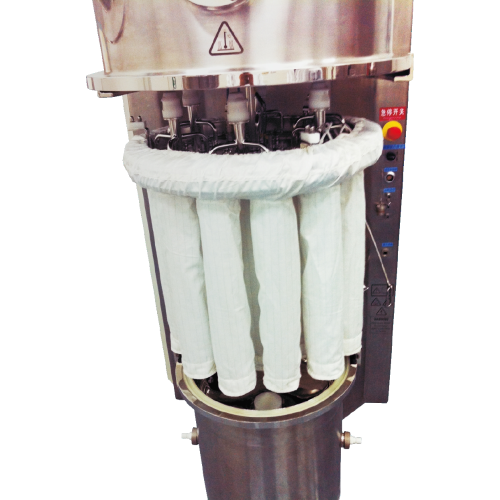
Automatic Tablet Press: High-Speed, Precision Tablet Manufacturing Solutions

Get a Free Quote

Our representative will contact you soon.
Email
Name
Company Name
Message
0/1000

automatic tablet press

The automatic tablet press is a high-performance pharmaceutical manufacturing machine designed to compress powdered or granulated materials into uniform tablets with exceptional precision and consistency. As a cornerstone of modern pharmaceutical production, this machine plays a critical role in ensuring that every tablet meets strict quality standards in terms of weight, hardness, thickness, and dissolution rate. Whether used in large-scale pharmaceutical factories or mid-sized nutraceutical facilities, the automatic tablet press delivers reliable output that supports both regulatory compliance and commercial efficiency. At its core, the automatic tablet press operates through a rotary compression mechanism. Raw material is fed into the die cavities, where upper and lower punches apply controlled pressure to form compact tablets. The entire process is automated, from material feeding and compression to tablet ejection and collection, minimizing human intervention and reducing the risk of contamination. Modern automatic tablet press machines are equipped with advanced control systems, including programmable logic controllers (PLCs) and touchscreen human-machine interfaces (HMIs), allowing operators to monitor and adjust parameters in real time. Key technological features include variable speed control, automatic lubrication systems, overload protection, and dust extraction units. Many models also incorporate in-process quality monitoring tools such as tablet weight sensors and rejection mechanisms that automatically remove out-of-spec tablets from the production line. The applications of the automatic tablet press span a wide range of industries. In pharmaceuticals, it is used to produce oral solid dosage forms including immediate-release, extended-release, and chewable tablets. In the nutraceutical sector, it manufactures vitamins, dietary supplements, and herbal tablets. It is also widely used in the chemical and food industries for producing effervescent tablets, catalyst pellets, and confectionery products. With output capacities ranging from tens of thousands to hundreds of thousands of tablets per hour, the automatic tablet press is an indispensable tool for any manufacturer seeking to scale production while maintaining uncompromising quality control.

New Product Recommendations

The automatic tablet press gives manufacturers a clear edge in production by combining speed, accuracy, and reliability into one streamlined system. Here is a straightforward look at the practical benefits that make this machine a smart investment for any tablet-producing operation. First, the automatic tablet press dramatically increases production speed. Unlike manual or semi-automatic alternatives, a fully automatic system can produce hundreds of thousands of tablets per hour without stopping. This means manufacturers can meet large orders on time, reduce backlogs, and respond quickly to market demand. For businesses looking to grow, this kind of throughput is not just convenient, it is essential. Second, it delivers consistent tablet quality every single time. The machine applies the same amount of pressure to every tablet, ensuring uniform weight, hardness, and thickness across the entire batch. This consistency is critical in pharmaceutical manufacturing, where even small variations can affect how a drug performs in the body. Customers and regulators alike expect every tablet to be identical, and the automatic tablet press makes that possible without relying on operator skill or attention. Third, the automatic tablet press significantly reduces labor costs. Because the entire process runs automatically, from feeding raw material to ejecting finished tablets, fewer workers are needed on the production floor. Operators simply set the parameters, monitor the system, and perform routine maintenance. This frees up your workforce for higher-value tasks and lowers your overall cost per tablet. Fourth, it minimizes material waste. The machine uses precise dosing mechanisms to fill each die cavity with exactly the right amount of material. Combined with built-in rejection systems that remove defective tablets before they reach packaging, manufacturers lose far less raw material compared to older methods. Over time, this adds up to significant cost savings. Fifth, the automatic tablet press is easy to clean and maintain. Most modern models feature tool-free disassembly, allowing operators to remove and clean contact parts quickly between production runs. This reduces downtime and makes it easier to switch between different tablet formulations without cross-contamination risks. Sixth, it supports regulatory compliance. The machine generates detailed production data that can be logged and reviewed during audits. Features like password-protected settings, batch records, and alarm histories help manufacturers meet the documentation requirements of agencies such as the FDA and GMP guidelines. Seventh, the automatic tablet press is highly adaptable. It can handle a wide range of materials, from standard pharmaceutical powders to sticky or abrasive compounds, and can produce tablets in various shapes, sizes, and configurations simply by changing the tooling. This flexibility means one machine can serve multiple product lines, maximizing your return on investment. In summary, the automatic tablet press is not just a piece of equipment. It is a production partner that helps you make more tablets, better tablets, and more profitable tablets, all while keeping your operation clean, compliant, and competitive.

Latest News

What is a mini tablet press machine and how does it work?

25

May

What is a mini tablet press machine and how does it work?

A mini tablet press machine is a compact, precision-driven piece of equipment designed to compress powdered or granulated materials into uniform tablet forms. Whether used in pharmaceutical research, nutraceutical development, or small-scale chemical...
View More
How do packaging machine components work together?

25

May

How do packaging machine components work together?

Understanding how packaging machine components interact is fundamental to running efficient, reliable production lines. Every element within a packaging system—from the feeding mechanism to the sealing unit—is engineered to perform a prec...
View More
How Does Press Tooling Quality Affect Final Product Results?

25

May

How Does Press Tooling Quality Affect Final Product Results?

In precision manufacturing, the quality of Press Tooling is one of the most consequential variables in determining whether a final product meets its dimensional, structural, and aesthetic specifications. Every stamped, formed, or punched component th...
View More
How Does Blister Packing Tooling Improve Production Speed?

25

May

How Does Blister Packing Tooling Improve Production Speed?

In high-volume pharmaceutical and consumer goods manufacturing, every second on the production line carries real cost. When facilities look for ways to accelerate output without compromising quality, the conversation almost always returns to the same...
View More

Get a Free Quote

Our representative will contact you soon.
Email
Name
Company Name
Message
0/1000

automatic tablet press

Precision Engineering for Consistent Tablet Quality

Precision Engineering for Consistent Tablet Quality

One of the most important qualities any tablet manufacturer needs is consistency. When you are producing thousands or even millions of tablets, every single one must meet the same standard. A tablet that is too light may under-dose the patient. One that is too hard may not dissolve properly. One that crumbles too easily creates waste and liability. The automatic tablet press addresses all of these concerns through precision engineering built into every stage of the compression cycle. The rotary turret design at the heart of the automatic tablet press ensures that each die cavity receives the same volume of material on every rotation. The upper and lower punches are machined to extremely tight tolerances, and the compression rollers apply force that is carefully calibrated and continuously monitored. This means the pressure applied to tablet number one is virtually identical to the pressure applied to tablet number one million. Modern automatic tablet press models go even further by integrating real-time weight monitoring systems. These systems sample tablets at regular intervals and automatically adjust the fill depth if any deviation is detected. If a tablet falls outside the acceptable weight range, the rejection mechanism removes it from the line before it can reach the collection bin. This closed-loop quality control system operates without any human input, which means quality is maintained even during long production runs when operator fatigue might otherwise become a factor. The tooling used in the automatic tablet press also plays a major role in quality. High-grade steel punches and dies are designed to produce tablets with sharp edges, smooth surfaces, and accurate embossing. Manufacturers can choose from a wide variety of punch configurations to produce round, oval, capsule-shaped, or custom-profile tablets. The ability to produce visually consistent, professionally finished tablets is not just an aesthetic concern. It builds brand recognition, supports patient compliance, and satisfies the visual inspection requirements of quality assurance teams. For manufacturers in regulated industries, the precision of the automatic tablet press also translates directly into audit readiness. Every compression parameter, from turret speed to compression force, can be logged and stored for review. This documentation supports batch record requirements and gives quality teams the data they need to investigate any deviation quickly and thoroughly. In short, the precision engineering of the automatic tablet press is not a luxury feature. It is the foundation of a reliable, scalable, and compliant tablet manufacturing operation.
High-Speed Output That Scales With Your Business

High-Speed Output That Scales With Your Business

Production speed is one of the most direct drivers of profitability in tablet manufacturing. The faster you can produce finished tablets, the lower your cost per unit, the faster you can fulfill orders, and the more competitive your pricing can be. The automatic tablet press is engineered specifically to deliver high-speed output without sacrificing the quality or consistency that your customers and regulators demand. Entry-level automatic tablet press machines typically produce between 50,000 and 100,000 tablets per hour. Mid-range models push that figure to 200,000 or more, and high-capacity rotary presses used in large pharmaceutical facilities can exceed 500,000 tablets per hour. These numbers represent a transformational leap over manual or semi-automatic equipment, which typically tops out at a fraction of that output. What makes this speed sustainable is the engineering behind the rotary compression system. As the turret rotates, multiple stations, each consisting of a die and a pair of punches, complete the full compression cycle simultaneously. While one station is being filled with powder, another is compressing, and a third is ejecting a finished tablet. This parallel processing is what allows the automatic tablet press to maintain such high throughput without creating bottlenecks. Speed alone is not enough, however. The automatic tablet press pairs its high output with intelligent control systems that keep the process stable at every RPM. Variable frequency drives allow operators to ramp speed up or down smoothly, and the control system continuously adjusts compression force to compensate for any changes in material flow or density. This means the machine does not just run fast. It runs fast and right. For growing businesses, the scalability of the automatic tablet press is a major strategic advantage. A single machine can handle current production volumes while leaving room to increase output as demand grows, simply by adjusting the operating speed or upgrading to a higher-capacity turret. This means manufacturers do not need to invest in additional equipment every time they win a new contract or expand into a new market. The automatic tablet press grows with your business, protecting your capital investment over the long term.
Smart Controls and Compliance-Ready Data Management

Smart Controls and Compliance-Ready Data Management

In today's manufacturing environment, producing a good tablet is only half the job. You also need to prove it. Regulatory agencies around the world require manufacturers to document every step of the production process, from raw material intake to finished product release. The automatic tablet press meets this challenge head-on with smart control systems and built-in data management capabilities that make compliance straightforward rather than burdensome. At the center of the modern automatic tablet press is a programmable logic controller paired with a touchscreen human-machine interface. This combination gives operators full visibility into every production parameter, including turret speed, compression force, pre-compression force, tablet thickness, and ejection force. All of these values can be set, saved as named recipes, and recalled instantly when switching between products. This eliminates the risk of operator error during changeover and ensures that every batch starts from a validated baseline. The data management features of the automatic tablet press go well beyond simple parameter display. The system logs every production event, including start and stop times, parameter changes, alarm triggers, and rejection counts, into a secure electronic record. These records can be exported in formats compatible with common quality management systems, making it easy to compile batch documentation for regulatory submission or internal audit. Access controls add another layer of compliance support. The automatic tablet press allows administrators to assign different permission levels to different users, so operators can run the machine and monitor output, but only authorized personnel can change critical parameters. Every login and every parameter change is time-stamped and attributed to a specific user, creating a clear and tamper-evident audit trail. For manufacturers operating under FDA 21 CFR Part 11, GMP, or similar frameworks, these features are not optional extras. They are requirements, and the automatic tablet press delivers them as standard. Beyond compliance, the smart controls of the automatic tablet press also reduce downtime. Predictive maintenance alerts notify operators when components are approaching their service intervals, allowing maintenance to be scheduled proactively rather than reactively. Fault diagnostics pinpoint the source of any alarm quickly, reducing the time needed to troubleshoot and resume production. The result is a machine that not only produces tablets efficiently but also supports the broader operational and regulatory goals of a modern manufacturing facility.


Get a Free Quote

Our representative will contact you soon.
Email
Name
Company Name
Message
0/1000