Precision Die Solutions for High-Performance Manufacturing Applications

Get a Free Quote

Our representative will contact you soon.
Email
Name
Company Name
Message
0/1000

die

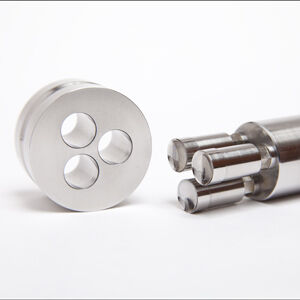
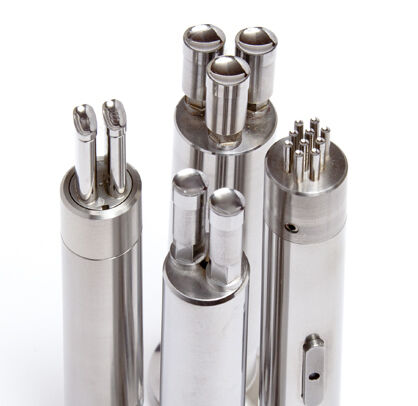
A die is a specialized precision tool used in manufacturing and metalworking to shape, cut, or form materials into specific geometries with high repeatability and accuracy. At its core, a die functions as a hardened mold or cutting instrument that applies controlled force to raw materials, transforming them into finished or semi-finished components that meet exact dimensional specifications. The die plays a central role across a wide range of industrial processes, including stamping, forging, extrusion, casting, and thread cutting, making it one of the most versatile and indispensable tools in modern production environments. From automotive parts to electronic connectors, the die enables manufacturers to produce complex shapes at scale without sacrificing quality or consistency. Technologically, a die is engineered from high-grade tool steels, carbide alloys, or ceramic composites, depending on the application and the material being processed. Advanced surface treatments such as nitriding, PVD coating, and hard chrome plating are commonly applied to extend the working life of the die and reduce friction during operation. Modern die design leverages computer-aided design and finite element analysis to optimize stress distribution, minimize wear, and ensure dimensional stability across millions of production cycles. CNC machining and electrical discharge machining are standard methods used to achieve the tight tolerances that high-performance die applications demand. The die finds application in industries as diverse as aerospace, automotive, electronics, construction, and consumer goods manufacturing. In sheet metal stamping, the die cuts and forms flat blanks into structural components. In wire drawing and extrusion, the die shapes continuous material profiles. In thread cutting, the die creates precise helical grooves on fasteners and pipes. Each application demands a die engineered to specific load, temperature, and wear requirements, underscoring the importance of material selection, heat treatment, and surface finishing in die manufacturing. As production demands grow more complex, the die continues to evolve, incorporating smart monitoring systems and advanced coatings that push the boundaries of performance and longevity.


New Product Recommendations

Choosing the right die for your production process delivers a set of practical benefits that directly impact your bottom line, product quality, and operational efficiency. Here is a straightforward look at what a well-engineered die brings to your manufacturing operation. First, a high-quality die gives you consistent output every single time. When you invest in a precision-manufactured die, you eliminate the guesswork from your production line. Every part that comes off the press or extrusion machine matches the same dimensional standard, which means fewer rejects, less rework, and lower material waste. For businesses running high-volume production, this consistency translates directly into cost savings and a more predictable manufacturing schedule. Second, a durable die reduces your downtime significantly. A die built from premium tool steel with proper heat treatment and surface coating can withstand millions of cycles before requiring maintenance or replacement. That means your machines keep running, your workers stay productive, and your delivery commitments stay on track. Frequent die failures are one of the most disruptive and costly problems in any stamping or forming operation, and investing in a well-made die is the most effective way to avoid them. Third, the die gives you the flexibility to produce a wide variety of part geometries without redesigning your entire production setup. By swapping dies, manufacturers can shift from one product configuration to another quickly, supporting shorter production runs and faster response to customer demand. This adaptability is especially valuable in industries where product designs change frequently or where custom orders are common. Fourth, a precision die improves the surface finish and structural integrity of your finished parts. When the die is machined to tight tolerances and finished with the right surface treatment, it produces parts with clean edges, smooth surfaces, and accurate profiles. This reduces the need for secondary finishing operations, saving both time and labor costs. Fifth, modern die designs incorporate features that make setup and changeover faster and safer for your team. Quick-change systems, guided alignment features, and standardized mounting configurations mean that your operators spend less time on setup and more time on productive work. Safety features built into the die design also reduce the risk of operator injury during installation and removal. Sixth, working with a reliable die supplier gives you access to engineering support and customization options that help you solve specific production challenges. Whether you need a die optimized for a difficult material, a tight tolerance requirement, or an unusual part geometry, a capable die manufacturer can tailor the solution to your exact needs. This level of support turns the die from a simple consumable into a strategic asset that supports your competitive advantage in the market.

Tips And Tricks

What is Press Tooling and How Does It Work in Manufacturing?

25

May

What is Press Tooling and How Does It Work in Manufacturing?

In modern manufacturing, precision, repeatability, and efficiency are not optional — they are the foundation of competitive production. Press Tooling sits at the heart of this foundation, enabling manufacturers across industries to form, cut, s...
View More
How Does Press Tooling Design Impact Production Efficiency?

25

May

How Does Press Tooling Design Impact Production Efficiency?

In high-volume manufacturing environments, the design of Press Tooling is one of the most consequential engineering decisions a production team can make. From cycle time to scrap rate, from die longevity to operator safety, the geometry, material sel...
View More
How Does Blister Packing Tooling Improve Production Speed?

25

May

How Does Blister Packing Tooling Improve Production Speed?

In high-volume pharmaceutical and consumer goods manufacturing, every second on the production line carries real cost. When facilities look for ways to accelerate output without compromising quality, the conversation almost always returns to the same...
View More
Which Materials Work Best with Blister Packing Tooling?

25

May

Which Materials Work Best with Blister Packing Tooling?

Selecting the right material for Blister Packing Tooling is one of the most consequential decisions a pharmaceutical or consumer goods manufacturer can make. The material determines not only how well the tooling performs during forming, sealing, and ...
View More

Get a Free Quote

Our representative will contact you soon.
Email
Name
Company Name
Message
0/1000

die

Precision Engineering for Unmatched Dimensional Accuracy

Precision Engineering for Unmatched Dimensional Accuracy

One of the most critical factors in any manufacturing operation is the ability to produce parts that meet exact dimensional specifications, batch after batch, without variation. This is precisely where a precision-engineered die delivers its greatest value. The die is manufactured using advanced CNC machining centers and electrical discharge machining processes that achieve tolerances measured in microns. Every cavity, cutting edge, and forming surface is crafted to exact specifications derived from detailed engineering drawings and validated through coordinate measuring machine inspection before the die ever enters production. The result is a tool that produces parts with consistent geometry, accurate hole positions, correct wall thicknesses, and clean edge profiles across the entire production run. For industries like aerospace and medical device manufacturing, where a deviation of even a fraction of a millimeter can render a component unusable or unsafe, this level of precision is not optional. It is a fundamental requirement. A well-engineered die eliminates the dimensional drift that plagues lower-quality tooling, ensuring that the first part produced matches the last part produced, even after hundreds of thousands of cycles. The materials used in die construction also contribute directly to dimensional stability. High-speed tool steels and tungsten carbide grades are selected for their hardness, wear resistance, and thermal stability, which means the die maintains its geometry even under the heat and pressure generated during high-speed stamping or forming operations. Surface treatments such as physical vapor deposition coatings add a hard, low-friction layer that further protects the die geometry from abrasive wear. For customers, this translates into fewer quality escapes, lower scrap rates, and reduced inspection costs. When your die holds its dimensions reliably, your quality control process becomes simpler and your confidence in your output grows. Investing in a precision die is ultimately an investment in the reliability and reputation of your finished products.
Extended Service Life That Maximizes Your Return on Investment

Extended Service Life That Maximizes Your Return on Investment

The total cost of ownership for any production tooling goes far beyond the initial purchase price. When you factor in the cost of die replacements, unplanned downtime, maintenance labor, and the disruption caused by tooling failures, the true economic impact of a low-quality die becomes clear. A die engineered for extended service life addresses all of these hidden costs by staying in production longer, requiring less frequent maintenance, and delivering a lower cost per part over its operational lifetime. The foundation of long die life starts with material selection. Premium grades of tool steel, such as D2, H13, and M2, are chosen based on the specific demands of the application, including the type of material being formed, the operating temperature, the cycle speed, and the required surface finish. These steels are then subjected to carefully controlled heat treatment processes, including hardening and tempering, to achieve the optimal balance of hardness and toughness. A die that is too hard will be brittle and prone to chipping, while a die that is too soft will wear quickly. Getting this balance right is a hallmark of experienced die manufacturing. Beyond the base material, advanced surface coatings play a major role in extending die life. Titanium nitride, titanium aluminum nitride, and diamond-like carbon coatings are applied using physical vapor deposition processes to create a surface layer that is significantly harder than the underlying steel. These coatings reduce friction between the die and the workpiece, which lowers heat generation and slows the rate of abrasive wear. The practical outcome for customers is a die that runs longer between sharpening or polishing intervals, maintains its cutting edge geometry through more cycles, and ultimately delivers more parts before requiring replacement. For high-volume manufacturers, the difference between a die that lasts one million cycles and one that lasts three million cycles represents a substantial reduction in tooling costs and a significant improvement in production uptime.
Versatile Application Across Diverse Materials and Industries

Versatile Application Across Diverse Materials and Industries

A defining strength of the die as a manufacturing tool is its remarkable versatility. The same fundamental principle of using a hardened, precision-shaped tool to form or cut a workpiece applies across an enormous range of materials, part geometries, and production environments. This versatility makes the die a cornerstone technology in industries as varied as automotive, electronics, construction, packaging, and aerospace, each of which places unique demands on tooling performance. In the automotive industry, the die is used to stamp body panels, structural brackets, and chassis components from high-strength steel and aluminum alloys. These applications require a die capable of withstanding extreme forming forces while maintaining dimensional accuracy across large surface areas. In the electronics industry, progressive dies produce tiny connector terminals, lead frames, and shielding components from thin copper and brass strip at very high speeds, demanding exceptional precision and surface finish. In the construction sector, the die forms structural profiles, fasteners, and hardware components from carbon steel and stainless steel, where toughness and wear resistance are the primary performance criteria. The ability of the die to be customized for each of these applications is what makes it so valuable. Die designers work closely with customers to understand the specific material properties, part geometry requirements, production volumes, and quality standards that apply to each job. The die is then engineered with the appropriate steel grade, heat treatment, coating, and geometric features to meet those requirements precisely. This customization extends to the die set configuration, including the choice of guide systems, spring arrangements, and stripper plate designs that optimize performance for the specific press and production environment. For customers, this means that regardless of the material you work with or the industry you serve, there is a die solution engineered to meet your exact production needs, delivering consistent quality, reliable performance, and a competitive cost per part.

Get a Free Quote

Our representative will contact you soon.
Email
Name
Company Name
Message
0/1000